The Empire Builder

We had been packed for several days, eagerly anticipating our departure on a train-bus-auto rental-public transit-and foot trip in Minnesota and Dakota. Tuesday morning, 17 May, 2016, I was awake a 04:00. The kind of awake that loudly announces The night is overt; let’s get on with it. Hearing no other stirrings in the dark room, I let Pat sleep until 07:00 and she rose with the echoes of Buddy and Jerri rising upstairs. So it began.

Cleaning up our basement room (once referred to as The Dungeon by Jerri), we parked our car in the alley behind the motor home, took out our trash and recycling, and carried our bags upstairs. Four  of them: Two Rick Steves rolling packs—one each, one computer backpack for electronics and an extra pair of Ron’s shoes, another smaller backpack of Pat’s…things, the purple LL Bean tote full of Pat’s mysteries, and a blue Thrive bag full of magazines and whatever to be left at the Kelso train station.

At 09:20, ten minutes late, Train 500 arrived and we boarded Business Class and were swept on our way. The seat trays were down and on one, an index card in hand-lettered print, Ronald. The other, Patricia.

A less than perfect ride, a wheel on our car was being noisy and rattled the window in front of us. We ran into more slowdown orders than has become typical for this run. But we lost time and made it up, and rattled and shook, and arrived in Seattle at worst only a few minutes late.

We had worried about loosing our precious and anticipated layover time, hoping to walk to Metzger Maps at Seattle’s Pike Place Market. Not to worry, we had plenty of time. We held the bags at Baggage, paid the $12.00 fee and set off to find a read for me and a deck of information cards as a present to Scott. And another Cascadia patch for my new travel bag.

A near capacity Train 8, The Empire Builder, left at 16:40 with us occupying Room 14 of Car 831.

The great watchdogs of Congress are unable to complain about the extravagant waste of space on Amtrak roomettes which is why they raised the issue of hamburgers a few years ago. The quarters are close in the most optimistic light. Once in our adequate bunk beds, however, we are fairly comfortable. Until then, any movement is a challenge and potentially painful.

DSCN1115.jpg

DSCN1135.jpg

Despite the closeness, the two night trip was comfortable and relaxing. The meals and service were good, our dining room table companions were pleasant and interesting, and the spring scenery varied and beautiful. The dwindling snow on Glacier Park peaks was compensated for by the lush green of much of the prairies of Eastern Montana and North Dakota. More meals, another night.

Awake early, we readied our bags and caught a quick breakfast before our arrival at St. Paul’s Union Station. The station, completed in 1926 and built in the classic train station style of that era, had been closed for decades before an updating and renovation project was completed in 2012. It now is a functioning multi-modal transit facility providing bus (local and regional), rail, and urban light rail for Minneapolis and St. Paul and the surrounding suburban region.

Our plan was to take transit as near as we could get to Pat’s brother’s home in Ham Lake. I had researched this before, but—just for sure—called a transit voice to hear it again. We missed one bus standing at the wrong stop but made the second, and were on our way to a transfer point in downtown Minneapolis.

A brief pause to provide some background. A few weks before leaving on this journey, we had joined our son, Scott, and family for a weekend at South Beach State Park at Newport Oregon. They were in the campground. We, fearing rain, took a motel. Knowing Grand daughter Paige loved swimming, we took a motel with a pool, and she stayed with us the second night. She swam. And swam.

Grandfather our writer took a shower. During the shower, he didn’t fall. He plummeted like a boulder off a cliff frequented by Eagles and Condors, smashing his eyebrow and left shoulder. Paige looked at the pool of blood and the mighty noise created by the plummet and said, “We should take Grandpa to the hospital.” Besides the obvious eyebrow, the kindly ER Doctor also mentioned the torn rotator cuff and how we should maybe have that looked at when we get home and have some time.

Paige thought the ER visit was really cool.

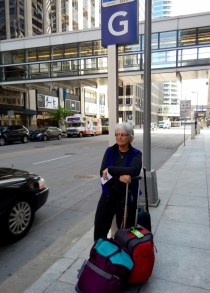
And now, back to our story. The bus stopped, just like the man said on the telephone, at area G where we were to disembark and wait for the other bus. As we moved to leave, Pat’s rolling bag tipped, spilling magazines and other sundry items all over the bus aisle. I grabbed and put my backpack partially on, took Pat’s backpack and my rolling bag and started down the stairs to exit and make room. Buses run on a schedule. We try not to make them late.

Of course I fell over. The weight of the bags threw me off balance and off the bus to land on my right knee skiddingly, removing a moderately important layer of skin, and then to fall further and slam my left shoulder into the sidewalk.

“Well, that should take care of that old rotator cuff,” I thought.

We regrouped, reorganized, and boarded the next bus, making it safely to Northtown Shopping Center and Duane’s waiting welcome.

“How was the trip?” he asked.

DSCN1151.jpg

Area G. Pat with bags. 

Posted in Uncategorized | Leave a comment

Palouse Falls

We have wanted to visit Palouse for years. And years. It all sounds so spectacular, so amazing. So remote. And after the beauty of Dayton, we were on the way.

DSCN0924.jpgThe road to Palouse Falls State Park is an adventure in its own right. We drove US 12 from Dayton to SR 261. For people like us who are bothered by heights and narrow, shoulderless roads, this perfectly safe paved road gets a reaction. Nervous hyper-vigilance seems appropriate. After turning off onto Palouse Falls Road, the ride gets bumpier. The road is a rutty gravel lane, badly beaten by sightseers and late night partiers. Arriving at the falls parking are, we encountered a mess of cars parked to avoid the entry fee or purchase of a Discover Pass. After checking our expired pass, we joined them, sliding our IQ into a tight but adequate spot.

Worn paths criss-crossed the park. People were everywhere. Off across the canyon, the ledges above the falls were lined with people looking down the falls in what must be a spectacular view. People were ascending and descending trails and hillsides. A few had made it down along the river, walking in the spray of the falls. A discussion of two or three words and we firmly decided that, given the crowds and the conditions, we would take our views from behind the safety fence.

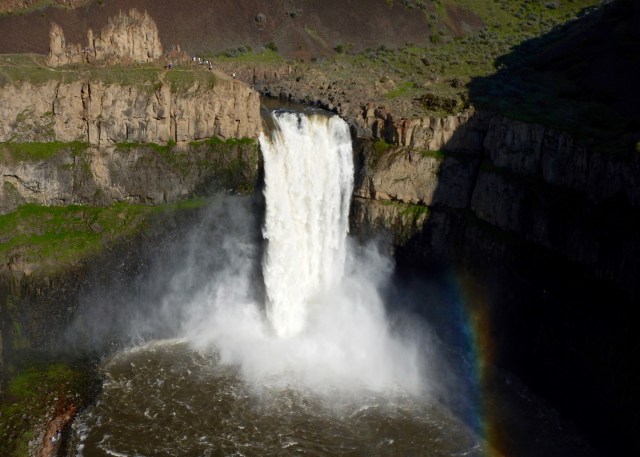
On February 12, 2014, Palouse Falls was declared the official waterfall of Washington State by action of the Washington State House of Representatives. One can hope the park will soon get some attention and needed upgrades equal to its status.The falls is spectacular with silt-laden water falling 198 feet.  Usually unnoticed is a twenty foot upper falls, located about 1,000 feet northwest of the main falls. Four miles downstream from the falls, the Palouse enters and becomes one with the  Snake River.

We watched the mists flying off the plunging tumult of water. Streaks of rainbow formed and disappeared. And the flow continued, unbothered by the seasons and ages. The river has moved, it’s original course now a dry coulee. But the water has remained.

I often wish I could see a speeded up movie of millennia long events. You know, like the films of rose buds opening or corn popping out of the ground and reaching seven foot maturity  a minute and fifty-four seconds later. The successions of lava flows—the Grand Ronde and the Wanapum basalt formations, the recurring filling and rupturing of the Missoula Floods: That would definitely be a two bagger.

Posted in Uncategorized | Leave a comment

Dayton, Lovely Dayton

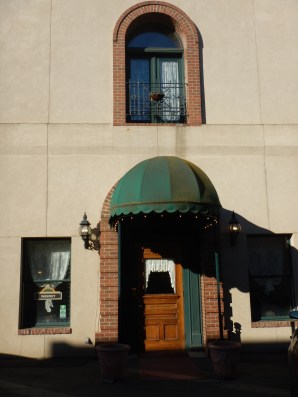
The day was warm enough for spring. We drove down Main Street (US 12) and pulled into a parking space across from an old hotel. We agreed “What the hell,” and crossed the street to check it out.

The Weinhard Hotel was built in 1890 by Jacob Weinhard, nephew of the Portland, Oregon beer tycoon, Henry Weinhard. Jacob arrived in Dayton in 1880 and bought into an existing brewery. Three years later, he had becDSCN0886.jpgome the sole owner and was already enlarging the brewery. He built the Hotel building to house a Saloon and a Lodge, both carrying the name Weinhard. The newspaper gushed that the Weinhard Saloon was “…perhaps the finest in the State of Washington, and we doubt if there is anything of the kind to surpass it on the Pacific Coast.”

The hotel has had its ups and downs as Dayton’s fortunes rose and fell. Its latest incarnation recalls its history in  the early 1900s.

Our room sported a beautiful canopy bed with classic art and family photos adorning the walls. Nearly all the hotel furnishings are antique. After settling in, we climbed the stairs to the upper floor roof top garden and its conversation areas and an off-for-the winter gas fire table. A Crow was obviously peeved at our presence and was letting the whole town know. We stayed a while, enjoying the view of Dayton and especially the historic train station just below and to the northeast.

We left the hotel and walked west toward the setting sun, turning south along the dike trail of the Touchet River. A pedestrian bridge was our turn-around, only a short distance down the trail. There, we were shyly greeted by several white tail deer and other walkers.

Good. The trail is used by locals. We returned to the trail as a major part of the city volkswalk the next day. The walk meanders through the near downtown area before reaching the Touchet River trail. We walked on the trail to the southeast corner where the Touchet wandered off to the south and we were transferred onto 4th to return to the downtown.

Dayton is a city of about 2400 people. Some of them live in magnificent and beautifully kept older homes built between 1880 and the 1920s. A few were run down, nearing a state of collapse, but they were not the norm. Old houses and churches, the beautiful old Columbia County Courthouse, and the restored train station behind our hotel show the results of a community that has taken preservation to heart.

At the restored depot, I met a woman—sorry, I don’t remember your name; I didn’t even
surreptitiously snap a photo of you—who talked about the efforts of her and others in the community to hold onto their historical homes and buildings.

The Dayton Historic Depot is the oldest surviving train station in Washington. In addition to a variety of train-related memorabilia, the station had a fine  show of recent and historical quilts. Given the displays and artifacts, it was easy to get a feel for travel in the late 1800s—the station was built in 1881’

DSCN0890.jpgWe found a home at the Chief Springs Fire and Irons Brew Pub, stopping by  several times for a beer and meal. Mike Springs, the owner (in partnership with his wife) and brewmaster, brews up surprisingly mild but tasty ales. Several years ago the Springs bought the pizza restaurant next door. Now wait staff shuttle pizzas and sandwiches through the back door.

We were in Dayton to visit the old train depot and make the 36 mile drive to Palouse Falls. Chief Springs pub was an unanticipated bonus.

Posted in Uncategorized | Leave a comment

A Beautiful Drive

We left Bend Friday morning, April Fools Day. Storing some winter things in Scott’s garage, we loaded our four travel bags, several shopping bags, two old purses, and randomly thrown shoes, using up most of the available space in the back of the Scion IQ. We paused to have some breakfast—Leslie and Scott are partial to smoothies, healthy homemade ones—and bid them our love and good wishes. We each tried one last April Fool caper on Paige: She saw right through it.

They drove off to their outside lives and, after some more looking into corners and under things, we were ready to go.

No simple getaway, not yet—we needed gas, coffee, money, and highway 2o. Pulling onto US 97 a few minutes after 10:00, we randomly stumbled through our appointed stops; only we did the order as money, coffee, gas, and finally the drop off 97 onto 20 and we were rolling eastward with a clear sky and only a few juniper-treed hills obstructing our view.. This is a  stark, lonely road, even with  traffic. The few remaining towns are being abandoned. Empty buildings in disrepair dominate. Ranches are scattered. Streams of dust in the distance indicate someone working a field or driving a graveled road.

The juniper landscape near Bend transitioned into sage brush as we drove.  “I couldn’t live out here,” said Pat, looking at mono-colored surroundings. I agreed but felt the pull of the nearby hills and gullies. I remembered the North Dakota rolling prairies in which I created my personal western movie as a child. I know how this feels.

I like Burns. With its distinctively western flavor, its nearness to Steens Mountain and the Malheur National Wildlife Refuge and its millions of migrating birds, it is a destination for birders of all sorts, bicyclists, wanderers, and, probably, the lost. The recent Malheur “occupation” by Bundy-inspired (no, not Al  and Peggy) anti-government reactionary anarchists sort of adds to its charm. We stopped for lunch (I don’t remember anything about it) and continued on Highway 20 to the east for the junction with US 395.

We turned north onto a road we had never traveled before and of which we knew nothing. By look and feel, it was another lonely road.

DSCN0863 (1).jpgSeneca, a town of about 200, lies in the Silvies River at an elevation of about 4690 feet, Ir holds the record for the coldest temperature recorded in Oregon at -54F in 1933.

Headquartered in Bend, the 140,000 acres of the Silvies Valley Ranch are spread on both sides of US 395. According to their website, the historic cattle ranch is developing a multi-directional future including beef production, a guest ranch and homesites, golf, land restoration, etc.  Identifiable by their uniform green roofs, we saw scatterings of buildings, herds of cattle, and signs of  development mile after mile.

Further up the highway, we stopped briefly at Canyon City, the county seat of Grant County. The city sits at about 3200 feet and is only a few miles from John Day, Oregon.  St. Thomas Episcopal Church had caught my eye. A wooden structure built in 1875, St. Thomas sits tightly between Washington Street and a hillside. Its architecture reminded us a little of the stave churches in Norway. Gold was discovered nearby in Canyon Creek in 1862. From there it is the oft told story of a rush of as many as 10,000 miners, a hastily constructed town and several fires that burned much of it. Built after the first fire (1870), St. Thomas survived the second and a later fire in the 1930s. DSCN0866

I wanted to see the interior of the church, but the front door was locked and we didn’t take the time to hunt someone with a key. The church web site showed only the usual photographs of Christians eating.

Earlier, the Strawberry Mountains showed beautifully around mountain curves. Pat drove and I worked the camera. Of all the photos I took of that marvelous , one photo of the Strawberries turned out.

Remember when we used to have to spend the money for developing pictures and buying more film before we found out we got a great shot of a utility pole? Another benefit of digital!

We dropped out of the hills into Pendleton, looked at each other and said, “Let’s keep going.” We rolled right onto Highway 11 and drove on. At one point, we were magically transported from 11 to Washington 125 and there was Walla Walla. Again, we glanced at each other and said, “Let’s keep going.”

In 1968 in Pierre, South Dakota, we were contemplating moving somewhere else. We had a friend who briefly had lived at Walla Walla and we enjoyed the name so much. Our joy and determination to come to Washington increased when we found on the same map the town of Hamma Hamma.

We have always enjoyed our visits at Walla Walla, especially as it developed its wine mecca personality. But this time we just rolled on by, knowing we could make Dayton before dark. “Let’s keep going!”


Posted in Uncategorized | Leave a comment

On to San Diego and Bend

Monday, 7 March, 2016

We are speeding—relatively—toward Eugene,  OR. We are in roomette 11, Car 1131. For the first time in our riding Amtrak Superliners, we are on the lower level, sort of at walking height rather than the upper, above-it-all level. We boarded at Kelso (KEL) at 12:36, seventeen minutes late from our scheduled departure.

The weather is March. We have had rain, dark clouds, sunshine, a brilliant rainbow and most everything in between. Subtle shades of weather, abruptly changing. Riding through flat farmland, the foothills of the coast range roll and peak west of us. Clouds dark to sunlit brilliant drift over the hills and over us.

A field with scattered clumps of daffodils marks the deep green meadow grasses with bold yellow stars. Farms slide by with blossoming trees, white and pale pink. Every depression in every field or pasture is a glassy watery pond or a ditch.

Here is spring at its boldest and most aggressive.

For several miles now, a field across a two-lane road from us is bordered with white daffodils.

Rolling toward San Diego, we are riding the Coast Starlight to its Los Angeles terminus and, tomorrow night at 22:10, boarding a Coaster train the rest of the way. It will be at least 01:00 when we arrive.

The story so far; We listed our house in September. The first week of  January we were given an offer which we argued for two minutes. The sale closed on 19 February.

Moving out was horrible. We lived at 106 River View Drive for forty years, collecting and planting and gathering and hoarding and accumulating. And then we moved. Habitat for Humanity came with a large truck, and then a larger one and another still larger. Day after day I hauled to Goodwill and Red Hat and libraries and school gardens.  Even more went to a large storage unit.

More blue sky and the sun an hour from setting. I am blinded by the brilliance of the light through my mobile ground floor window.

Buddy and Jerri,  kind and sympathetic people. not only took a box of our composting worms, they took us in and are letting us stay in their basement. Which we also filled with our things that we didn’t give away or hauled to the landfill or what wouldn’t fit into the storage unit. Things we thought we might need.

Our intent may be to remain homeless through the summer. Moving to Bend OR has a strong pull. It is a lovely city in the high desert of central  Oregon, at the edge of the Cascade peaks of Batchelor, Broken Top, the Three Sisters and others that have names that left me at a curve about ten miles back. Paige and her parents, Scott and Leslie, live in Bend. She is our only grand child and she talks about her homeless grandparents and would take us to Show and Tell at her school.

Scott, our oldest son, is entering an Oregon State University Masters and teacher certification program, beginning in July. Paige’s mom works full time and so who better to supplement their wonderful parenting and teach a six year old all she will need to know to have a proper attitude toward life?

We are paused at the Eugene OR station. I  have a photo taken about twenty yards south of where I now sit from August 2014. We were on our return from Flagstaff and the Grand Canyon. I remember we both walked briskly along the train’s length to revive our bodies. This time we didn’t leave the train.

Tuesday, 8 March, 09:20

We have had breakfast. I had the special, a pancake scramble with two pork sausages, orange juice, and two cups coffee. I say that because breakfast is the most important meal of the day. Although I have heard unwise people pooh pooh that fact.

16:00 In the Parlor Car listening to jazz

(originally tuned in for a wine tasting in which we didn’t participate) while around us are wandering conversations about wine, surf, beach, weather, waves, the Air Force and careful lightings on politics given the recent shooting of an Idaho pastor who prayed at a Ted Cruze rally.

We are now paralleling the shoreline not far below us.

A few ticks before 02:00 we crawled out of the yellow Prius taxi at 521 Market Street in San Diego. I got out from the front seat, Pat eased out of the back followed by one of the two Canadian women with whom we shared the cab. The other slid out the other side of the vehicle and waited for her luggage. We noted the noise, the brightly lit streets and crowds of partiers exiting bars in any direction. “The bars have to close at 02:00 AM,” said the driver. Checking in, we schlepped our bags to the elevator and Room 321.

I dreamed our train was stopped, clued by the lack of any rocking motion.

We spent a lot of our San Diego time at Balboa Park. Our first crossing was while walking the San Diego Harbor volkswalk. The…Route goes along the San Diego Waterfront to the east end of the airport runway, then through Balboa Park, around Petco Park (home of the San Diego Padres), through the Gaslamp Quarter, up over the Convention Center, through Seaport Village, past the USS Midway Museum, the cruise ship docks, past the Star of India sailing ship, and back to the start point. it said that in the walk description. We added to it a stop at the Monkey Paw Brew Pub. We arrived at Balboa Park after a tedious slog up Laurel Street. We returned to Balboa Saturday morning for the St. Patrick’s Irish parade and celebration. During the parade, I worried for any emergencies in the city; it seemed every police and fire personnel was in dress uniform marching. Spiffily so. The parade did its finest with several pipe bands. We lost our program on the train and so can only refer to The Pipers.

A day earlier, I visited the Museum of Man and climbed the California Tower. Climbing the tower is only done in tour groups and we ascended to the second last level. Our guide pointed out a Mexican butte that was visible, nearby eastern mountains, and a crow’s view of the layout of the city. The forbidden last spiral staircase was off limits because of risk factors, said our guide. We had already waived our potential lawsuits for whatever reason but they were still unwilling to let us kill or maim ourselves.

The beautiful Spanish Mission architecture, design, and landscaping of the park was the set for the 1915-1916 Panama-California World’s Fair, opened in competition with the larger San Francisco World’s Fair. The buildings that now line the beautiful streets and plazas are rebuilds, permanent structures that replaced the temporary fair facilities.

And back to our volkswalk: Following the provided map, we strolled the busy Convention Center that fronts a goodly stretch of waterfront full of large yachts and sailboats. This was the haunt of serious fitness addicts who ran the waterfront. Some ran the waterfront and zoomed up the stairs to do push ups while calmly eying our slow upward plodding. To me it seemed like some mass hysteria played out on the steps of an urban temple. Pat did mention,  between loud stair-climbing gasps that all these people look damned good and in wonderful shape. The disgust in her voice was pronounced.

We were walking downtown on Wednesday when Pat stopped in mid step and pointed at the marquee on the Spreckles Theater. “Loreena McKinnett” it spoke to us. We entered the theater door and emerged a few minutes later with tickets for the next evening.  Loreena’s musical ability and her abiding interest in Celtic forms turned out a wonderful show. A year earlier we saw her at the Seattle Zoo summer concert. Rather than the large orchestra of that concert, this performance was a trio (plus one for several numbers).

Pat talks to people much more than I do. In one of her conversations, she learned of a tavern in the theater district with a great variety of beers and very good food. Friday evening we decided to eat there. Now in this fine city of San Diego, weather is always temperate and Edenesque. A divinely appointed mist met us outside the hostel door and gently sent us on our way to our supper. The mist turned to drizzle, the drizzle to rain, the rain to a deluge. We ate, drank, and dripped. I waited for someone to say, “It never does that here.”

We were awake before 05:00 Monday morning. The overnight desk person at the hostel called a taxi, wished us good travels, and we were at Santa Fe station by 05:35, ready for Leg 1 to Los Angeles and “home”.

Monday, 14 March, 22:10. Aboard the Coast Starlight, Car 1431, Room 13, our return “home.”

We are starting to move, pulling out of Oakland station. Friends we made at breakfast (two young women en route to their own spring break fling in San Francisco) and  after supper, the three as old as us German-born army brides who have lost their husbands and now travel together. In the morning, our eating companions may pass each other on the San Francisco street and we will be in Oregon.

Traveling carries a variety of obligations. Many checklists are handed to us. Our values decide which of then—if any—we follow. I don’t worry at all about being fashionably correct, appropriate, or current. I wear what I have. Most of what both of us travel in lasts, deals well with dirt and staining, and will cause little grief were we to lose or damage it. I bought it on sale or closeout or from a thrift shop.

Other, more important questions impose themselves: Who’s being exploited, mistreated, or evicted for my benefit? What size carbon footprint does my activity create? Who benefits from this?

Questions of authenticity also occur. Theme Parks for example almost by definition engage in altering, sanitizing, re-interpreting, or exaggerating history or the characters in that history.  Their purpose of entertainment is not history. or veracity.

Let me nuance my case. Even our Amtrak diesel engines are less carbon polluting than an airliner. That matters. It also matters—or should— that here on the train we experience getting there. This ride, over thirty hours in length, allows a pleasant transition from there to there, from Kelso to San Diego. It can keep us connected with the passing landscape, the weather, and the fact there are human landscapes from there to there.The world becomes a little more connected.

Ir also gives opportunity to connect with and relate to fellow travelers. At meals, in the Parlor Car, coach seats nearby, the roomette across the narrow hall…all provide social opportunity. Actually, they also provide solitary opportunity, as I often wish.

My favorite train time is breakfast. First, I love breakfast and believe it is indeed the most important meal of the day! People go out and spend  a bundle on a nice, expensive dinner. I am much happier with a less expensive but glorious breakfast. The best conversations on a train seem to happen at the breakfast table. A fresh coffee, a simple menu, “Where are you headed? Where did you board?” Let the stories begin!

We arrived at the Kelso station on time. Buddy and Jerri were waiting for us. We had a few days to read mail and reorganize our things before driving off in our overstuffed Scion IQ for Champoeg State Park, 25 or so miles south of Portland. There, we spent a night in a cabin with Scott and Paige and then, not having been able to get a second night’s cabin reservation, moved to the Red Lion in Salem. And its pool in which Paige swam several thousand miles. We then we formed a two vehicle convoy to cross the Cascade Mountains to Bend.

Our purpose here is to be grandparents—to be with Paige during her spring break while Scott and Leslie work.

Paige’s physical gifts, energy, and vocabulary growth continue to impress us. Her sense of humor, ability to convince  with both logic and illogic, and her artistic flair make her a delight even as she wears us out. Remember each of us is a trained observer of people so we would never allow any excess into our opinions.

Paige had her first ice skating experience with Pat. They cautiously entered the ice of the three month old Pavillon. Pat hasn’t skated for a few years and for a while, they and the wall provided stability for each other. After I returned  from a sabbatical at the Deschutes Brewery (conveniently located literally across the street) they were gliding around like a pair of Sonjas or Tonyas.

Posted in Uncategorized | Leave a comment

Patty & Ronny go to the Grand Canyon

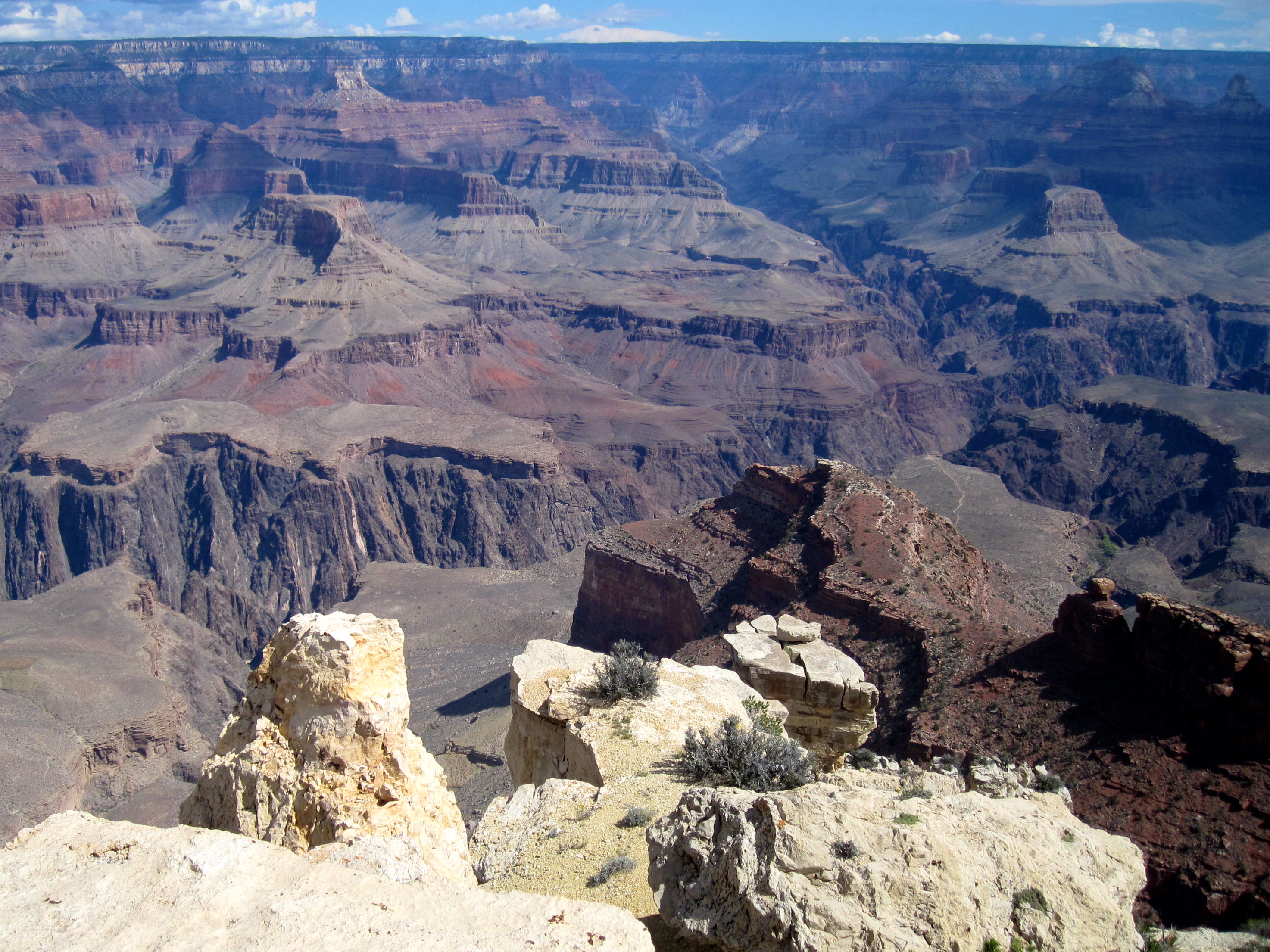
First view of the Canyon

First view of the Canyon

The ride was interesting enough. We rode the Arizona Shuttle in what I think is called a utility van–larger, roomier, and higher than the typical van. There were ten of us and included two young Chinese female tourists who carried their lunch in a cardboard box.
Stopping at Williams to pick up a passenger from the Grand Canyon Railroad Hotel, we saw several of the train sets cued up for travel to the Canyon. After Williams, we traveled up SR64 over a vast arid plain of dry grass, cactus and sagebrush. We looped past the iMAX Theater just outside the Canyon to drop off one person and continued on to the Maswik Lodge, final stop for the Shuttle.
Two volkswalks are listed for the South Rim Trail. We took neither of them, instead we turned west onto the trail paralleling the Red Canyon Rim shuttle route with intent to make it to Hermits Rest, the end of the trail.
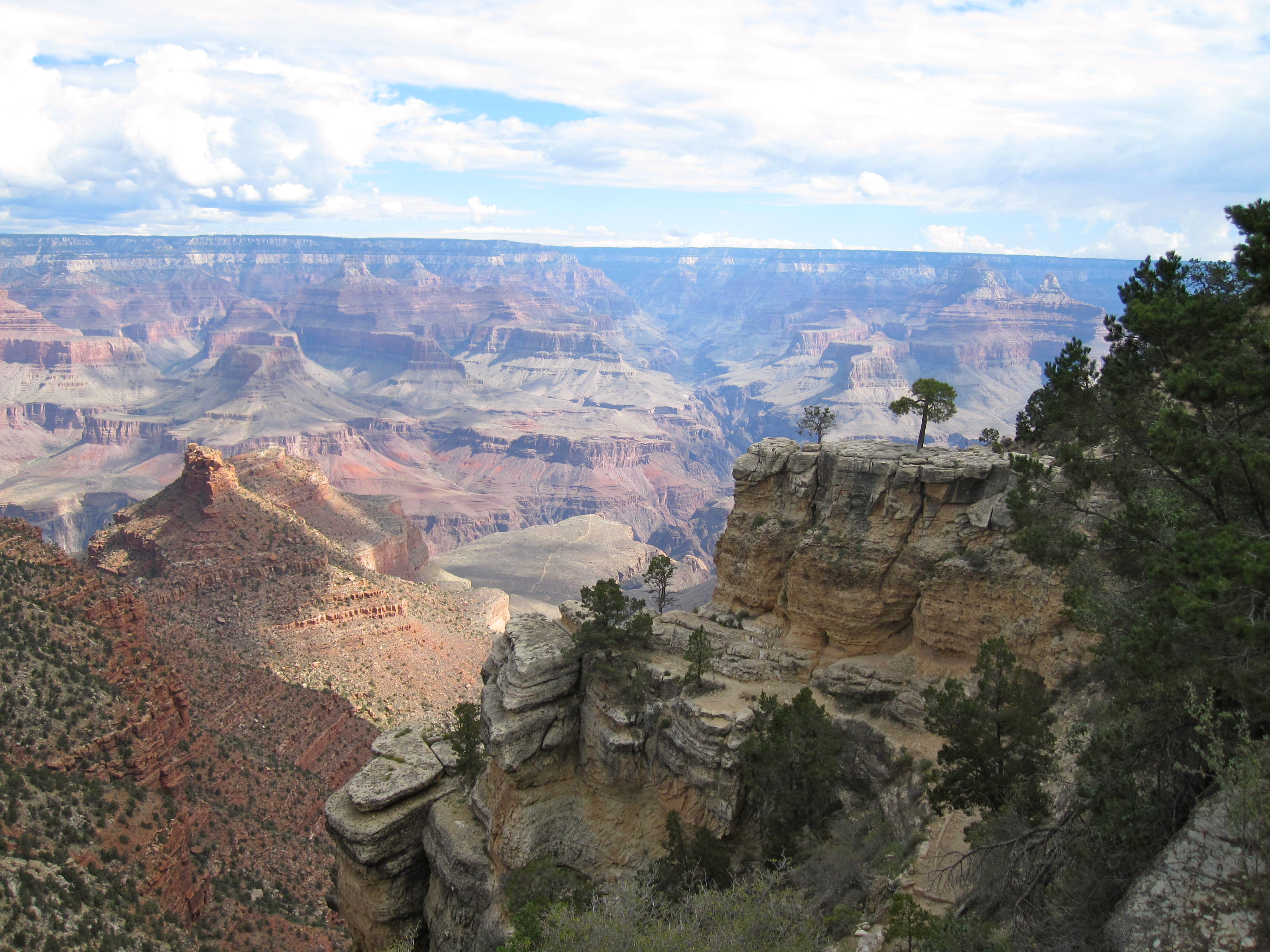
The day was still cool. Broken cumulous clouds were drifting across the sky. A weak breeze periodically rustled drying leaves–a perfect walking day. Parking areas and shuttle bus stops are frequent along the route, each signaled by groups of people who left their cars or came off the bus for the view. Few wandered far at all from the stops. Many couldn’t, being in wheel chairs or hobbling along on crutches, or slowly walking with dragging steps. Still, most held a camera or smart phone at the ready. A few struggled under the weight of tripods, professional-sized cameras, and assorted equipment.
Several times we encountered artists, singly or in groups, working in front of their easels and measuring a magnificent view. They were being photographed as often as the layered red rock below.

Over the Edge

Over the Edge

A little past Maricopa Point, a French-speaking family walked out on a broad, flat ledge. Typically, the teens in the group crowded toward to the abyss, while the older ones stood farther back, nearer the trail. The father, holding his camera, shook his head and said,”I can’t even stand to take a picture!” The blond daughter, wearing a white skirt and red top, sidled toward the edge and threw up her arms in a triumphant pose. I threw up my camera and got the photo.
The Canyon was clear, but a bluish haze intruded toward the North Rim. I have found that intensifying the color a little lets the haze increase the sense of depth in the photographs.
The first and last portions of our trail were paved to make the trail more accessible and, especially at the west end, to accommodate bicycles. As we later neared the far end of our 12.5 km walk, it also made our feet hot. The remaining unpaved section of the trail proved the most natural and enjoyable. No artificial trail surface held our attention. We were in and part of the path, rock, dust, and rises and dips.

Sometimes you can get a balanced photo. Sometimes not.

Sometimes you can get a balanced photo. Sometimes not.

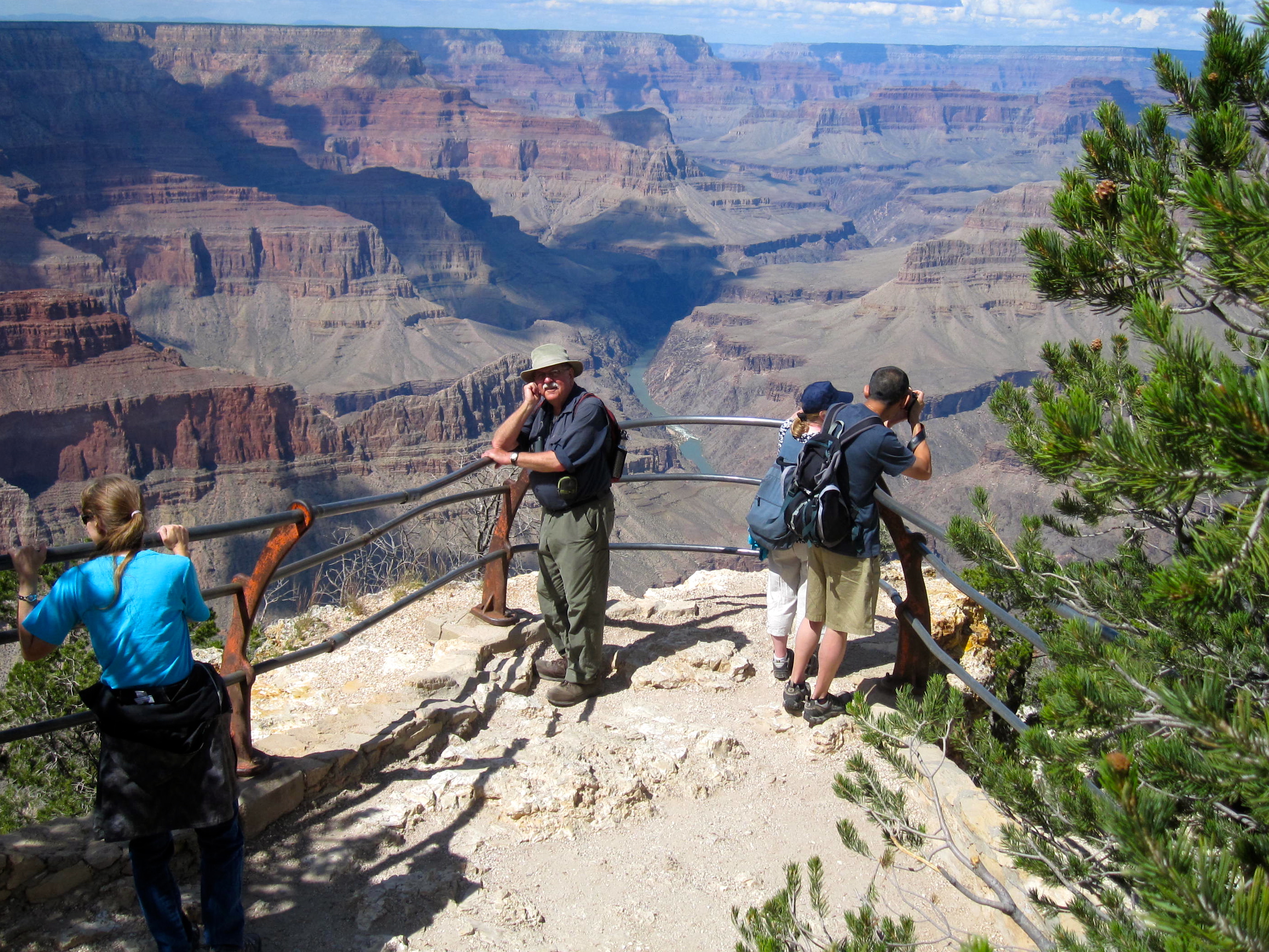
Several times the trail gave dramatic views of the wall of the South Rim. From our angle, view points with groups standing near the edge atop 500-3000 foot vertical drops both amazed and frightened us. That long, vertical perspective also affected our experience of looking down at other viewpoints!

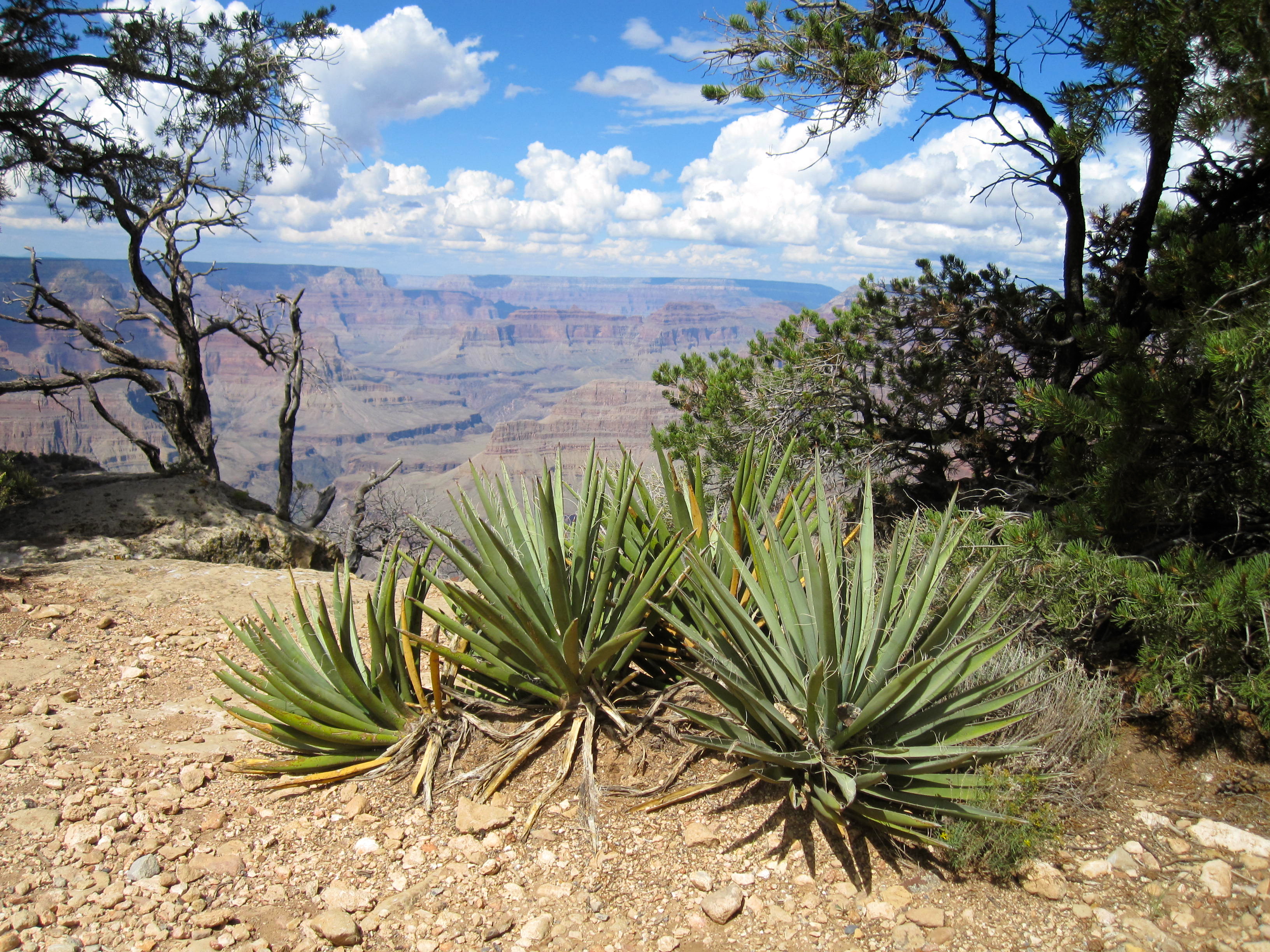
In the Garden

In the Garden

Further along the trail, Powell Point is the site a large and dramatic memorial to the explorer, John Wesley Powell. Thirteen steps lead to a bronze plaque honoring Powell’s 1869 and 1872 expeditions down the Canyon’s river. Only a few days after our visit, Pat read a part of Over the Edge: Death in Grand Canyon (Michael P. Ghiglieri and Thomas Myers, 2001) which suggested Powell may have been involved, directly or indirectly, in the deaths of three members of his explorer company, brothers Oramel and Senaca Howpaland, and William Dunn. No smoking gun is found, but enough connections and coincidences are offered to at least make an interesting story.
Near Hopi and Mohave Points the Canyon offers several good views of the Colorado River far below the trail.Crowded posing
We watched clouds massing and darkening as we walked, and after a while, the tell-tale streaks of a rain storm were visible, heading our way. Lightning and thunder moved into the mix, lending both drama and beauty to our experience. Quickening the pace, especially after a few splatterings of solo raindrops appeared on the paving, we saw the welcome Hermit’s Rest sign, the spring water spigot wall, the wash rooms, and the shuttle bus pulling out.
It was obvious not much dry time remained. We drank fresh water, walked to the shop, got a few photographs, and were at the front of the line when the next shuttle pulled in. We were on board when the rain shower hit.
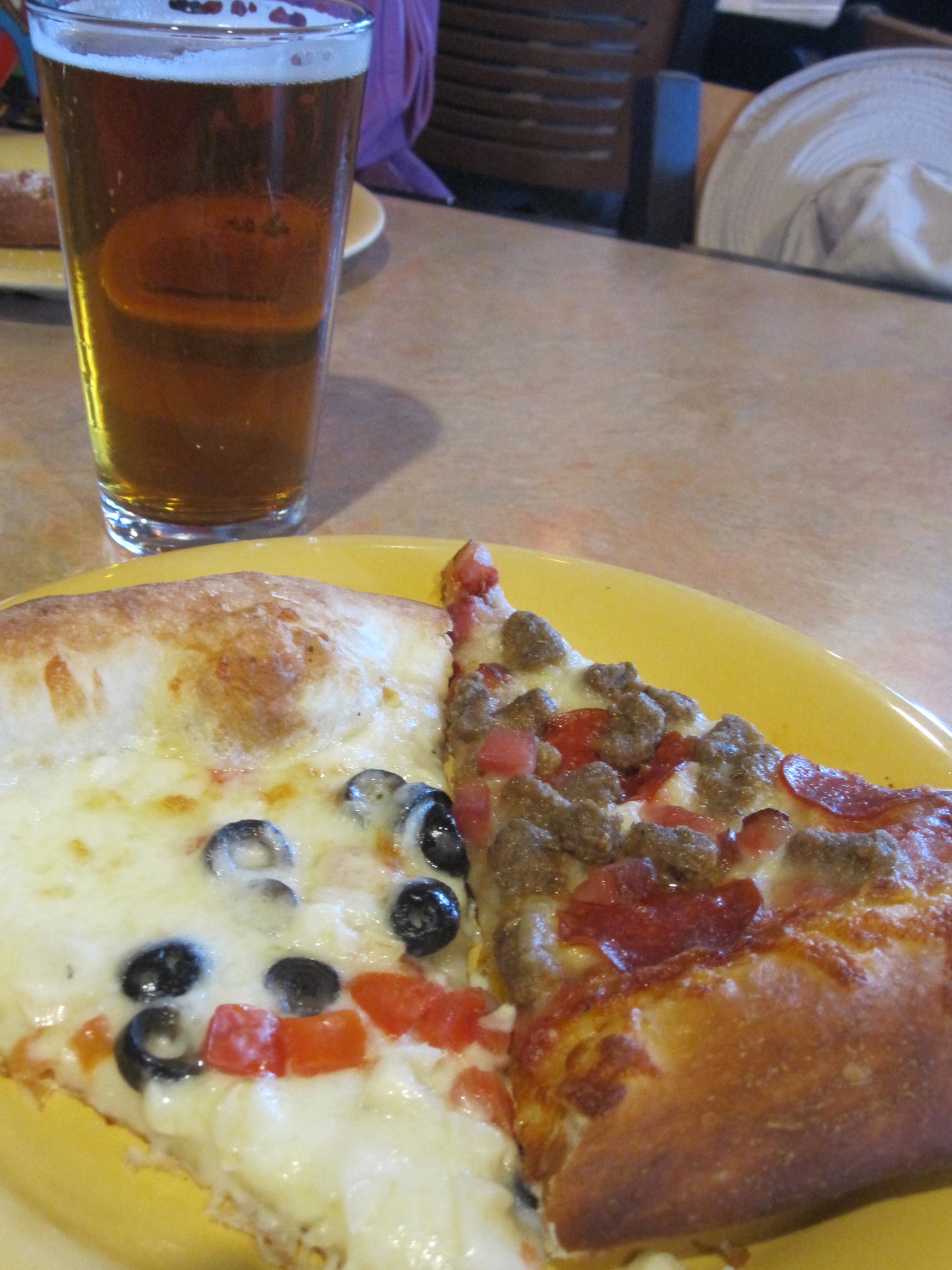
As we rode the shuttle back to the Lodge, I saw that my hope to pick up the remaining eight km to walk the entire South Rim Trail had been washed out. Exploring the first few steps of the Bright Angel Trail, we returned to the Maswik Lodge for beer and pizza, and lodged ourselves in the gift shop.

In the Garden

Posted in Uncategorized | Tagged , | Leave a comment

LA to Flagstaff

Our train pulled out at 18:15 as we settled into our sleeper and watched Los Angeles drift by. What we could see of the sunset was hazy with a mean yellow light.
We jumped up for the 20:00 dinner reservations call and hurried to the dining car. Being among the last to eat, several menu items were no longer available and we both ate steak.
A tap at our door. “We’ll be in Flagstaff in about thirty minutes.” We arrived a few minutes early for our 04:36 scheduled arrival and stepped out into the cool and very dark night air. Our bags delivered, we took a seat in the station with three other couples and two singles. The first to leave were our neighbors on the train, whisked off by an Arizona Shuttle van.
The station agent was very accommodating and held our luggage as we left the station at 06:15 and walked to breakfast and coffee at the Downtown Diner. The Diner, with country playing a little too loudly for our ears and with a smattering of old men drinking coffee, was true to its name. The coffee was weak and the little sealed cuplets of half and half wiped out any of its taste. Our food was unsophisticated but substantial and good and we ate.
I called the hotel and they had a room for us. We returned to the station to retrieve our bags and began the trek down Beaver, right at Butler, and left on Milton. Every town and city has a Milton, a main drag connecting to freeway, double (or more) lanes, never empty of cars. Milton is lined with fast food eateries, a few local restaurants and shops, and car services. The lights are separated by several blocks and create a temporary lull in the stream of rushing traffic. After a night sleeping on a swaying train, our balance and energy were down and our bags soon became heavy with a nervous weariness. Our home is sixty-two feet above sea level. Now we gasped for air at 7,200 feet. And then we were in our room, dropping the bags and flopping on the king-sized bed to finish our night’s sleep. At the station, someone had suggested we call a cab. We righteously replied, “We need the exercise.”
Our room was seven or eight blocks from downtown Flagstaff. A little more than a block south of us was a Mountain Line bus stop, a surviving Barnes and Noble was a little more than a block up the street. Further north, a Natural Foods store with a huge holstein cow mural faced Milton. Across from us, the campus of Northern Arizona University spread almost to the downtown. All this and more we learned by wandering around after our rejuvenating nap. We were well-placed.
The next day, we rode the bus to the start of the Woodland Trail volkswalk and walked the out-and-back route to Fort Tuthill Park, site of the annual County Fair, open-air concerts, and various horse events. Built on a former logging rail bed in Ponderosa Pine forest, the Woodland Trail is one of a complex of well-used urban trails in and around Flagstaff. We met bicycle riders, ravens, runners, squirrels, Flickers, vultures, Jays, a number of speedy fat rodents resembling prairie dogs, and, near the return end, a delightful couple older than us who told us about a winter in the 1970s when Flagstaff had eight feet of snow.
We ate supper at the Flagstaff Brewery, across from the train station. A busy, active pub with excellent food and wonderful ales, it has a large outdoor seating area where we found a table for two. The handlebars of a bicycle chained to the fence protruded through and provided a fine place to hang my hat.
The next morning, Friday, and our son Scott’s 45th birthday, we boarded the 07:45 Arizona Shuttle bound for Williams and the Grand Canyon.

Posted in Uncategorized | Leave a comment

As Far As LA

Eco Cab picked us up in a sparkling new Tesla. We got out at the KEL Station, stored our bags in the office, and walked to Grounds for Opportunity for some breakfast and coffee. GFO is a CAP sponsored training restaurant for unemployed and poorly prepared workers. A simple breakfast sandwich of sourdough bread, a sausage patty, fried egg, and cheese served me well. Pat was equally satisfied with her croissant and bacon sandwich.
We were out on the platform and ready to board when Train 11, the Coast Starlight, pulled in right on time, at 12:19. Sante, our Car 31 attendant, led us to Room 6 and we settled in for the ride.
The Coast Starlight, one of the Amtrak long distance trains, consists of bi-level cars for both coach and sleeper passengers. It is a lumbering old thing, very heavy, and usually about 12 cars in length. On this train, the Pacific Parlor Car was on line. Being a remnant of an older train, its floor sits six inches lower than the newer cars and that makes the passageway from the sleeper car a bit dicey, especially on rough track.
Our attendant had made lunch reservations for us and we dropped our bags in the room and walked to the dining car. We both ate chicken: Pat a chicken salad and I roasted breast with potatoes and gravy. Both were good, and a little more than we needed after our recent breakfast. Pat returned to the Parlor Car to spend the afternoon with a bunch of British and New Zealand drinkers and story tellers. I remained in the room to read, write, and nap.
From Portland south, the Willamette Valley was under the cloud of eastern Oregon wildfires. The clear sky was a hazy grey and near the horizon, a yellowish brown. The 90F weather gave us basically the kind of ugly, smoky, dusty, and dry late summer day I seriously dislike. As we neared evening and traveled past Eugene, the sky seemed to clear, a little.
We ate supper in the Pacific Parlor car. It’s not that different from the other cars, except its long history. But then most of Amtrak’s stock is aging.
Since Pat had been AWOL most of the afternoon, and I didn’t know where to find her, I made our reservations and ordered her a salmon salad. I asked for the lamb. The brilliant thing I did was to order an Arrogant Bastard Ale in the big bottle. It was a perfect fit to the rich gravy and flavors of the lamb. I balanced a rich, heavy meal with a rich, heavy ale and achieved a delightful synchronicity.
We haven’t traveled on a long distance train for several years now and have lost our edge for negotiating tight spots with luggage and big feet. It’ll come back, but it’s awkward. We figured we’ve traveled these trains in sleepers cross country several times before. In 2012, we traveled the VIA Canadian from Toronto to Vancouver, a four day ride. It’s both comfortable and workable. We just have to remember how.
The dining car is my favorite place on the train. Of course, I love food; but it is also a wonderful setting for meeting people, telling stories, and sharing travel. The randomness of the seating is a conversation lottery. This morning, we at with a large couple from Toronto. She was a German-from-Russia born in Ukraine, and he a Ukraine descendent. They are extensive travelers who like to talk about their experience. At lunch, we were with a businessman from Ventura and a young man who works as a tour guide for an adventure travel company. He was on his way home to a short vacation and then work on the family farm through the winter.
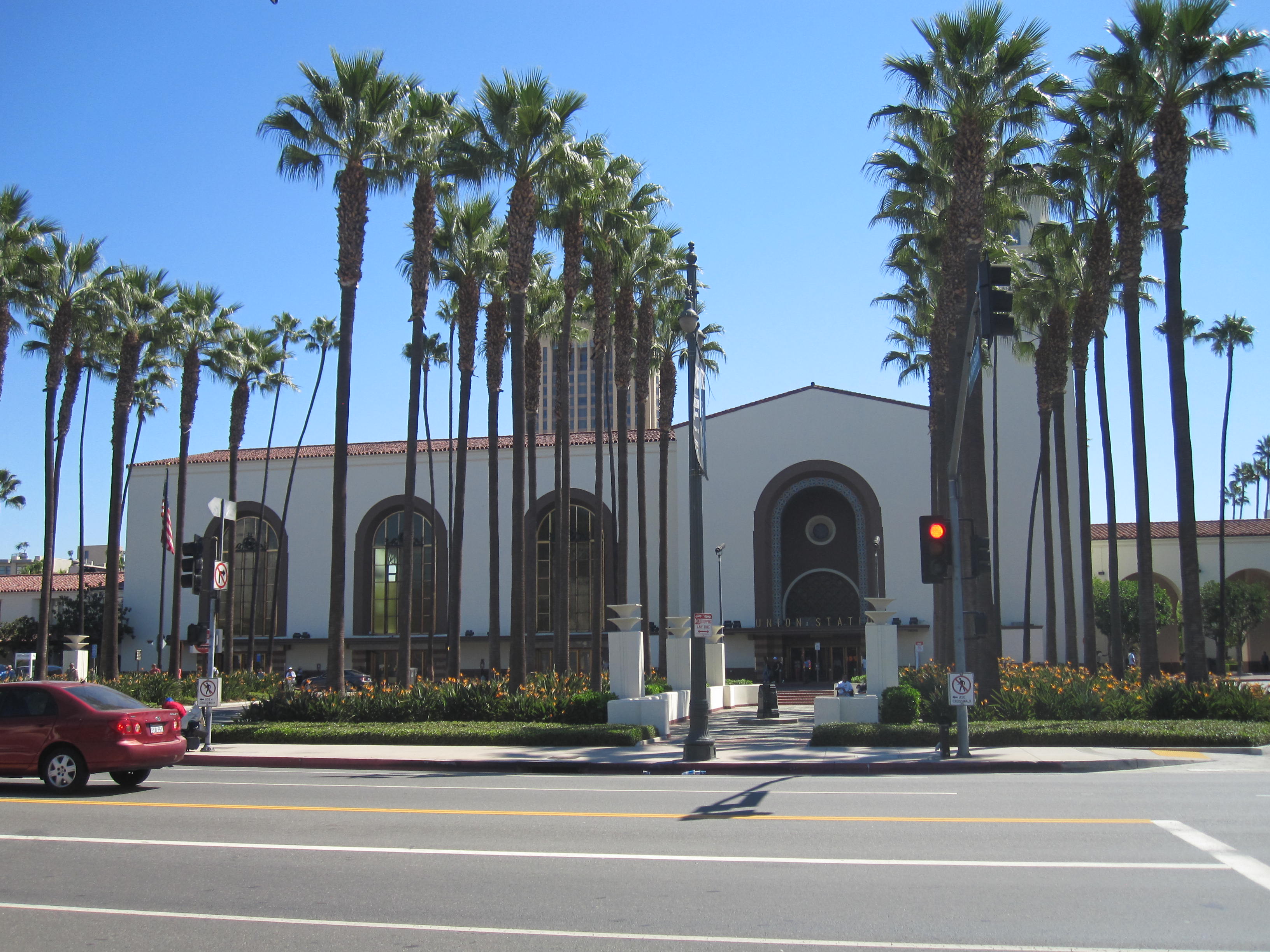
We arrived at LA Union Station at 21:00, a bit early and with just a touch of dusk remaining. The air was humid and hot, still in the upper 80s. I did a quick check with a security person, “Any trouble on the streets?” She replied, “They’re full of tourists!”
I thanked her and we headed out the door. We could see the bright neon sign over the top of the Pueblo building, “Metro Plaza Hotel” and aimed right for it.
By the time we walked through the door, my shirt was soaked with perspiration on my back under the backpack and under the shoulder straps. We checked in and headed up to our room 330, cranked up the AC and dropped our packs, bags, and clothes. Pat took a shower. We slept well.
I was awake at 04:00 and again at 06:15. After a shave and shower, I felt like having a day. We ate the meager motel breakfast with several cups of coffee and repacked our bags, sorting into the large bags everything we would not need. Walking to the station, we checked our large bags and climbed the stairs to the Metropolitan Lounge to drop off our daypacks before heading out.
We wandered the historic pueblo area, where what became Los Angeles had its start. A continuation of yesterday’s celebration honoring Mexican Independence was going on with a small demonstration and teach-in, music, and good feelings for those of Mexican descent. We wandered the shops, visited the 1818 Avila Adobe house–the oldest in LA, ate lunch, and kept up on fruit, water, and beer as the temperature pushed into the mid 90s.
Near the plaza is the la Iglesia de Nuestra Senora (the Church of Our Lady). Dedicated in December 1822 and renovated during the last century, it is a small, beautiful Spanish church of period art including a dancing portrait of St Francis the happy! I watched a grandmother bring her 18 month old grandson to the alter and knelt there with him. The beauty of it all made us forget the heat.
Sacramento Station Stop

<img src="http://theobliviouswalker.files.wLA Union Stationordpress.com/2014/09/img_4959.jpg?w=300″ alt=”IMG_4959″ width=”300″ height=”225″ class=”alignnone size-medium wp-image-22″ />

Posted in Uncategorized | Leave a comment

Falling Water

The misting began as I pulled off I-84 onto old US 30, the Columbia River Highway. By the time I passed Multnomah Falls and stopped at the Wahkeena Falls parking area, the mist had morphed into rain, making a busy rattle on the car roof. Turning off the engine, I listened to rain accompanying the Autumn section of Vivaldi’s “Four Seasons.” Rubbing my knee–the one I overstressed hiking up Herman Creek Trail to the Pinnacles the previous day–I worked on holding my “Whatever” attitude. I thought OK then. I’ll start and if it gets too slippery and dangerous, I’ll turn back, no problem. I thought about that a while longer and decided it probably was what I intended to do. I pulled on my knee brace, coat and hat and stepped outside. Adjusting the hiking staff, I began walking the Return Trail to Multnomah Falls Lodge to the beat of  “The Happy Wanderer” playing in my head. “I love to go a-wandering along the sodden track…”

Paralleling the highway, the trail gradually dropped to Multnomah Falls where I met–not counting the rain–my first disappointment: The coffee shop wouldn’t open for another forty minutes. Rather than wait, I began walking the steps and paved trail to the Simon Benson Bridge (1915) across the face of the falls. Crossing to the east, I began following the remainder of the 1.1 mile trail to the top of the falls, 542 vertical feet above. The trail is a series of gentle switchbacks, each view giving another perspective of the Columbia Gorge.

I turned onto a paved side trail and walked the .2 miles to the Multnomah Falls viewpoint, located directly over the spot at which Multnomah Creek takes a dizzying leap over the sheer rock ledge to fly and bounce down the cliffside. Another “OOOH!” moment for tourists from Nebraska.

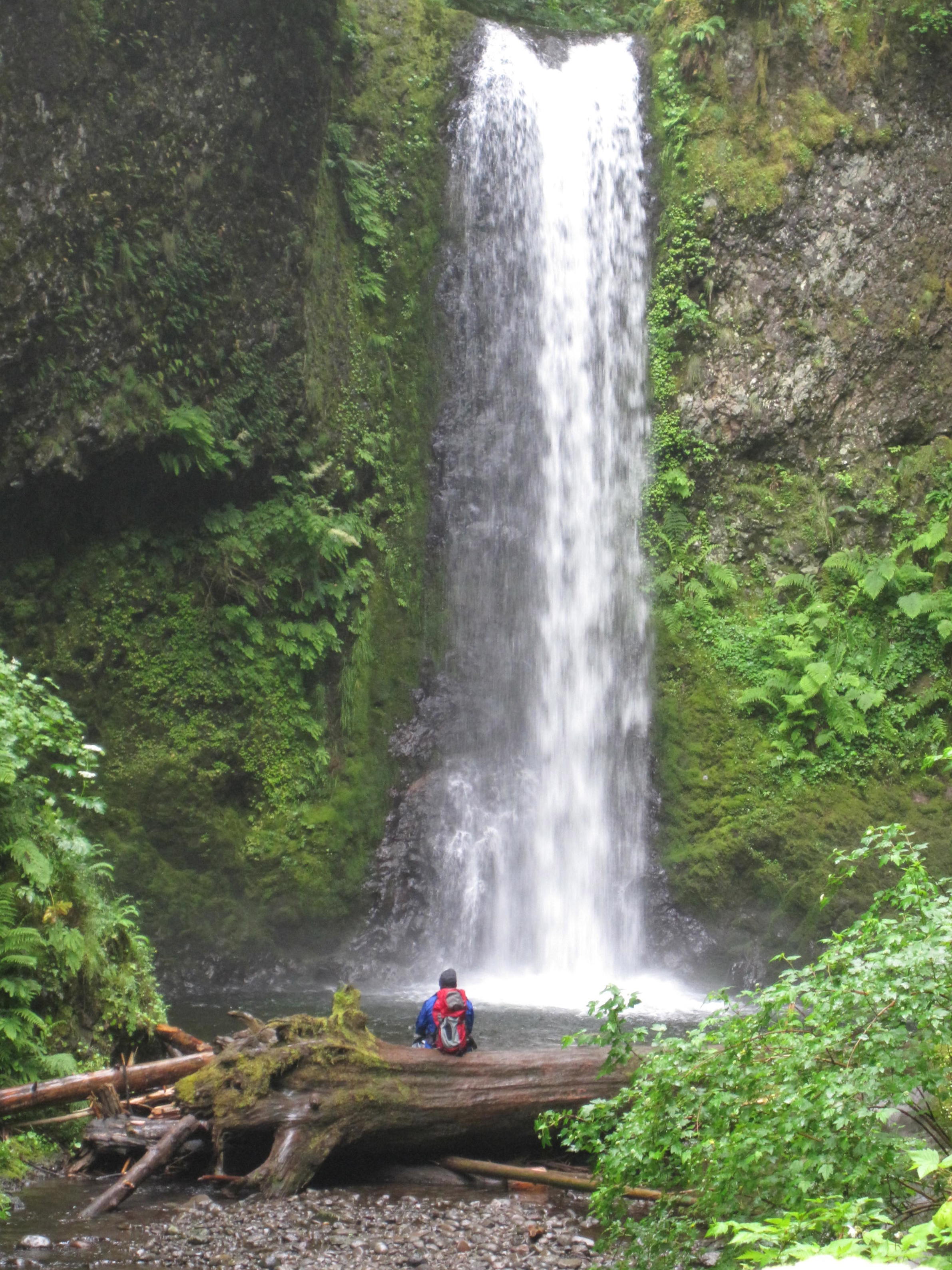
Returning to the Larch Mountain trail, I continued walking, entering a canyon where the trail was squashed between Multnomah Creek and a basalt wall. For the next twenty minutes, views of fifty foot Wiesendanger Falls drifted in and out of the trees as I moved upward.  For all the time the Falls was in view, a person with a red daypack hanging over a blue rain jacket sat on a huge log at the front of the falls. He sat leaning on his left hand with his body cast toward the horizontal umbrella of the log’s roots.  The scene was lovely, serene, and the simple reason why we go out there. As I continued on, I waved down to him. He didn’t notice, or, at least, he didn’t respond. He was doing something much more interesting than waving to old men.

Wiesendanger Falls

Wiesendanger Falls

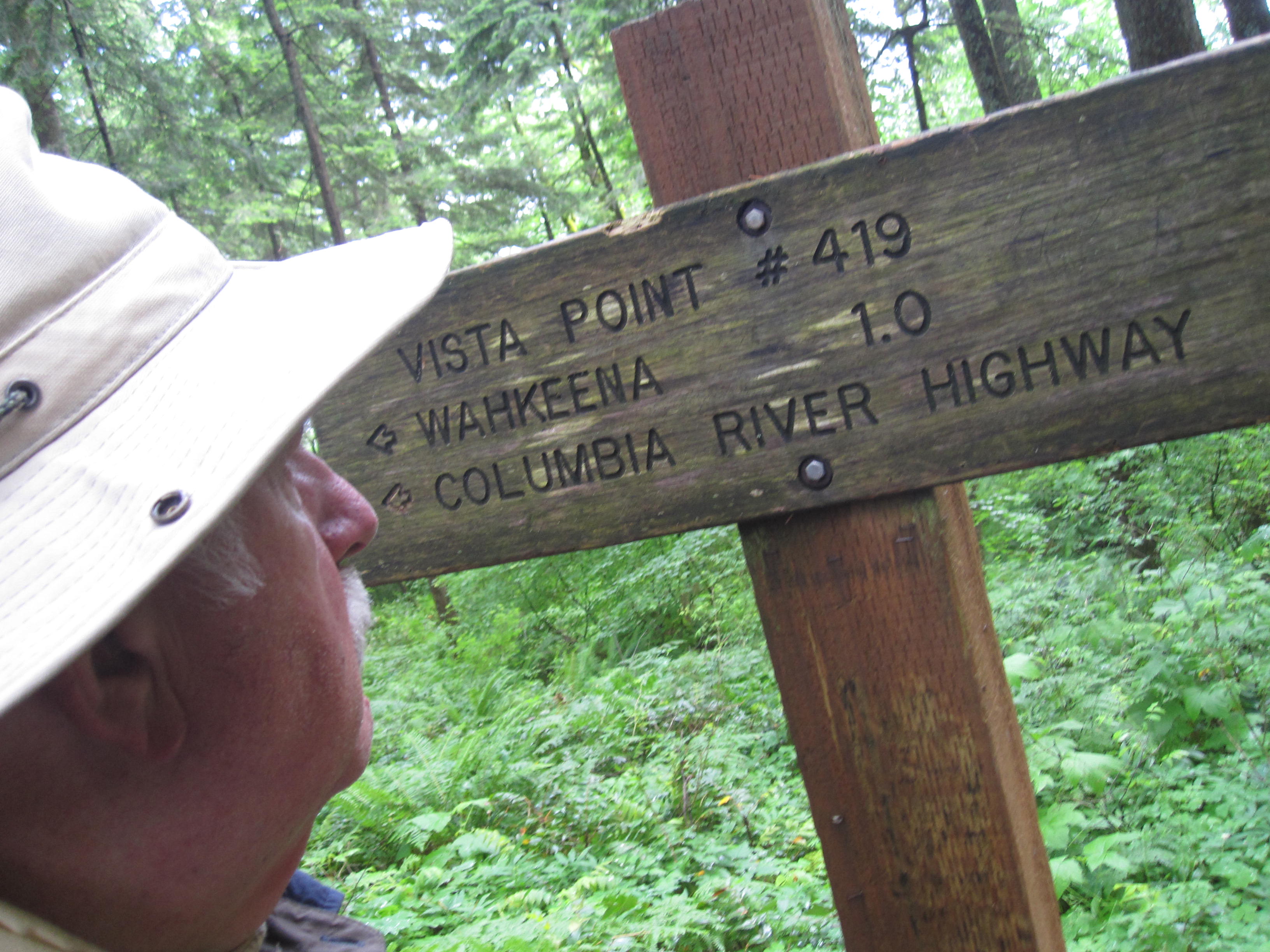
Reading Trail signs isn't always easy.

Reading Trail signs isn’t always easy.

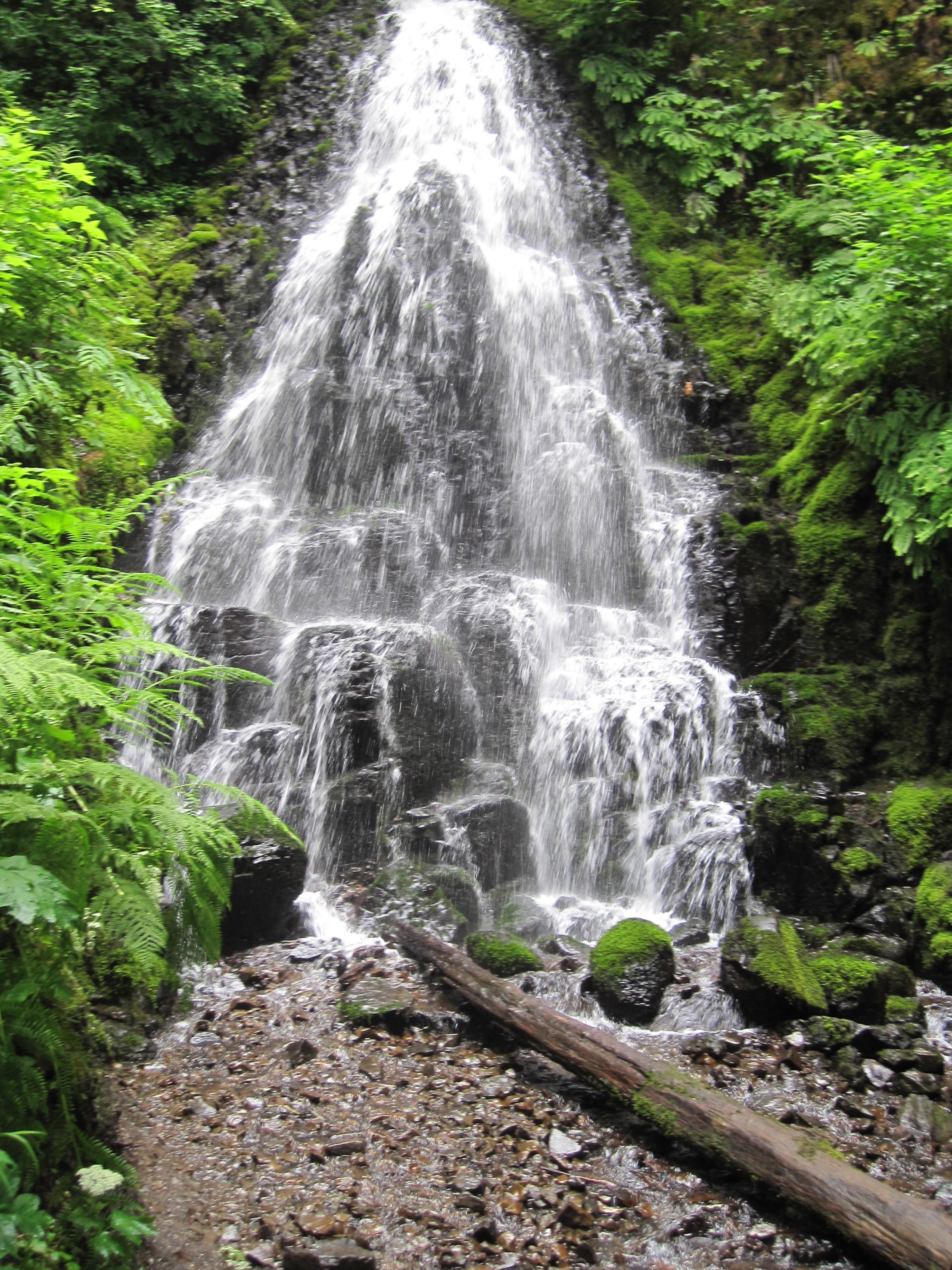
Fairy Falls

Fairy Falls

I continued my plodding slow climb, finally crossing a small ridge with the rush of Ecola Falls dropping almost directly below me. An odd name for a mountain waterfall, Ecola means whale in the Chinook language. My mind pictured a pod of Orcas leaping the fifty-five foot height of the falls like so many migrating salmon. It would be spectacular to watch!

As I had been walking, the raindrops gave way and recalled the earlier mist which in its turn faded.  A small patch of blue showed over the hill tops to the west. Rain is basic to this country, and it is, of course, what we complain of the most. All these streams and waterfalls depend on the seventy-five inches of annual precipitation at Multnomah Falls.

I walked slowly, finding a pace that I could continue for hours without stopping (what would be the value of that?). I walk slower than most walkers. Stopping and looking with either awe or curiosity is essential to my walking. Being there–stopping and listening to wind, water and waterfalls, birds, or simple silence is equally essential.

This day, I was walking more carefully than usual, always using my hiking staff as a third leg and wishing sometimes I could use it as a prehensile tail! My knee was sore and injured. I knew that if I took a serious fall, I would probably not get back up and would need a tow truck. And I knew that as I tired and the pain increased, my leg’s reliability and stopping ability would decline. Walking slowly enough to watch for all that and also see and hear the beauty all around me required constant and careful attention.

Being nothing of a botanist, I capture photos of flowers and then peer endlessly at collections of on-line photos. Sometimes I email my pictures to friends to mine their impressive knowledge of plants and wildflowers. Or I can make up German names and say I don’t know what it is in English. People expect that of me. As  I continued up the trail, one photo was of yellow starlike flowers identified as Senecio bollamderi (Groundsel) and Iris tenax (Oregon flag), an orchidish flower. My friend Mara gave me the identification. If I carried a guide book, I would walk even more slowly.

Time had disappeared. I left the Larch Mountain Trail and was now on the Wahkeena Trail passing the trail junction to Angel’s Rest and descending to a  meeting of several trails. Someone earlier had warned me about this upcoming crossing of paths. Searching my memory, I could not recall what I was to look out for.

There were trail signs in the area. Problem was they didn’t seem to bear any relationship to the simple map I was using. A good place for a break, I thought, and slipped off my day pack to remove the bottle of now warm water and find the apple and trail bar. I was in a clearing in a junction of trails, a pleasant place to rest. I experimented with narcissism–taking selfies as I studied the trail signs.

Two young men came down the trail I had traveled. I greeted them and learned they were also descending the Wahkeena Falls Trail. They read one trail sign and then the other. The taller of the two stood at the second sign consulting his map and glancing over at me. I shrugged. They set off on a westerly direction after a brief but serious conversation. “Hey, good luck,” I called after them.

By the time I was ready to leave, betting on a trail that led downward into a thickly forested area, six women in two groups were standing together, looking at the same signs and consulting the same maps, repeating the moves and saying the thoughts as I and the two young men had done. They argued about which trail to take but agreed I was setting off on the wrong one. “It doesn’t matter,” I muttered to no one, “It all goes downhill, and it’s all beautiful!”

A mere ten minutes later, I encountered four more walkers sharing what sounded like a happy reunion. I asked, “Where the hell are we?”

A woman with sparkling green eyes stepped toward me and pointed. “That way is to Wahkeena Springs. It’s an out and back but don’t miss it. Wahkeena Creek comes pouring out from under a rock.” She made a partial turn and pointed ahead of her. “And that’s Wahkeena Falls Trail.  It follows the creek down to the parking lot.”

She was right. A few minutes later, I watched Wahkeena Springs gush from under the rocks on which I stood. Flowing with the tug of gravity, it formed a small pool, dived under a nurse log, and disappeared into a mass of green shrubs, small trees, and probably some swamp creatures. Almost Edenesque.

Retracing my steps, I began my descent down Wahkeena. It is a small tumbling creek abundant in decorative stones. Like a hundred others, it cascades down the slope of the Columbia River Gorge to join and become one with the great river.

Most of the trail is rocky. A mixed blessing, it hurt my feet while it gave a semblance of traction. A little farther down the trail, I learned that wet rocks were only a little better than a long slope of wet clay. What was that doing here? If I started sliding, I stood a good chance of catapulting into the stream! I slowed even more, edging toward the basalt wall to my right. Carefully placing each foot and the hiking staff over and over, I edged downward to where the trail leveled and went into a turn. I don’t remember breathing during my short descent until I stood at the turn, gratefully grabbing lung-filling gasps of air.

I was quite certainFairy Falls, a twenty foot vertical cascade, had been built by fairies. Large dark stones are carefully stacked in a pyramid. At the top, waters pour over and cascade over the rocks, making a large white lacy shawl.

Lemmons’ Viewpoint, at about 600 feet elevation, is a memorial to Keith

Lemmons, an area firefighter who lost his life in a fire in August 1983. Just a few steps off the trail to a narrow point are broad views of the Columbia Gorge and the Washington side of the river. Set in a large stone, a plaque tells of Mr. Lemmons, his love of this area, and his untimely death. A family of three was leaving the point as I read the memorial, and I was alone with the memory of one who died over thirty years ago. I wrote that earlier in my hike, time had stopped; not an unusual experience in places like the Columbia Gorge. Here we encounter changes that occurred both cataclysmically as eruptions or the Missoula Floods, and incredibly slowly, as Wahkeena Falls carving its path into the rock. Thirty years, a drop in time measured against hundreds of thousands of years.  And I am sure there are people who still miss Keith. Carrying a little bit of his memory, I returned to the trail.

Further down, Wahkeena Creek rushes down the several levels of 242 foot Wahkeena Falls and gathers in a small pool at the bottom before continuing its tumbling journey to the river. Over the eons, the Falls’ downhill path has eroded into the basalt rock. At its top, a narrow line of sky showed in the slit and blended into the falling water. Nature has artfully supplied grasses, ferns, and mosses to coat the bare rock in gentle greens. At the base of the falls, a large log jutted out toward the trail, its own journey to the river interrupted by bad engineering. It was stuck. The log looks like it has been there a few years.

I crossed the stone bridge in front of the falls, taking photographs and looking up at the little strip of sky showing at the top. All those raindrops have done their work well here, it occurred to me.  The constant rush of water provided a sound barrier and I quickly was drawn into this place. I could turn into rock. I could sit here for ages, even showing up in guidebooks as The Stone Man. 

I abruptly reappeared to the sound of a child’s voice shouting, “Look! A big one.” I assumed he wasn’t referring to me. He was Scout, spying the waterfall as he checked the trail a few yards ahead of his father and two sisters. Father asked if I’d come across the top and shared that they will keep going up until someone begins complaining or gets hungry.

The spell broken, I returned to the trail and–I surprised myself–willingly walked toward the rising sounds of I-84.

The parking lot had one other car in it when I arrived in the rain four hours earlier. It was now full of cars with others slowly driving through, patiently patrolling the lot for a sign of an opening parking spot.

Posted in Uncategorized | Tagged | Leave a comment

Greetings

A revived blog–my place to tell stories (all with a bit of truth in them), offer opinions, throw fits, and maybe drop off some humor or gentle misbehavior. I’m old. Misbehavior isn’t as effortless as it once was.

Ron

Posted in Uncategorized | Leave a comment